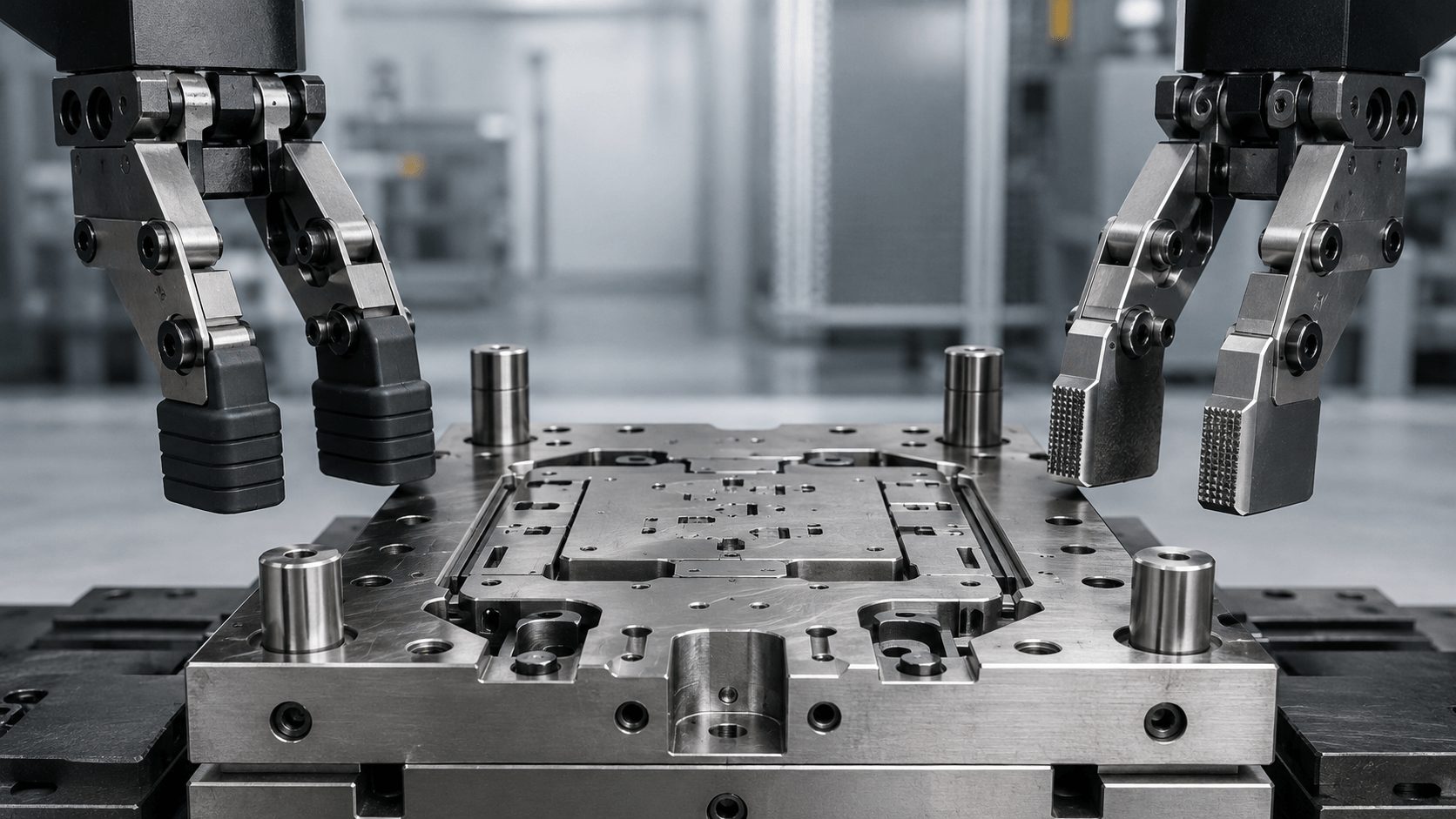
Key Takeaways
- Rubber tips offer gentle, cushioned contact — ideal for fragile, thin, or surface-sensitive dies.
- Carbide tips deliver extreme hardness and heat resistance — suited to high-force, high-durability handling.
- The right choice depends on die sensitivity, process temperature, and required tool lifespan, not on one tip being universally “better.”
Which is better for die handling — rubber tips or carbide tips?
There’s no single winner. Rubber tips and carbide tips solve different problems in semiconductor die bonding. Rubber tips protect fragile dies through cushioned contact; carbide tips provide the hardness and heat resistance needed for demanding, high-cycle operations. Choosing correctly means matching the tip material to the die and the process, not defaulting to whichever tip is already on hand.
What Are Rubber Tips and Carbide Tips?
Rubber tips, also called rubber collets, are pick-up components made from soft, flexible materials designed to cushion delicate semiconductor dies during handling. They’re built for gentleness — absorbing shock and distributing contact pressure evenly so fragile surfaces aren’t scratched or cracked.
Carbide tips are precision-engineered components made primarily from tungsten carbide, a compound valued for its extreme hardness and wear resistance. Rather than cushioning the die, carbide tips prioritise dimensional stability and long-term durability under repeated mechanical stress.
Both are used across die bond, wire bond, and tape-and-reel machines — the deciding factor is what the die itself can tolerate.
How Each Tip Type Handles Dies
Rubber tips in the pick-up cycle:
- The tip makes soft contact with the die surface
- Flexible material absorbs pressure variance, reducing point-load stress
- The die is lifted and transferred with minimal risk of surface marking
Carbide tips in the pick-up cycle:
- The rigid tip contacts the die or ejector interface with precise, repeatable geometry
- Hardness maintains a consistent contact profile even after thousands of cycles
- The die is ejected or positioned with tight dimensional control
This is the core trade-off: rubber tips flex to protect the die; carbide tips hold their shape to protect the process.
Materials Compared
Rubber Tips
Leader Hi-Tech’s rubber tips are available in standard NBR (Nitrile Butadiene Rubber) and high-temperature Viton variants rated up to 250°C, with hardness options spanning 50HRC to 80HRC. Additional materials include Silicone Rubber (heat resistance, chemical stability), EPDM (elasticity and wear resistance), and Polyurethane (higher abrasion resistance for high-throughput lines).
| Property | Rubber Tips | Carbide Tips |
|---|---|---|
| Hardness | 50HRC – 80HRC | 82HRC – 85HRC |
| Max working temperature | Up to 250°C (Viton variant) | Up to 2000°C |
| Best suited for | Fragile, thin, or surface-sensitive dies | High-force, high-cycle, high-precision ejection |
| Surface interaction | Cushioned, low-mark risk | Rigid, dimensionally stable |
| Typical use case | Bump dies, LED packages, sensitive surface dies | Standard/flat/step ejector needles, sorting automation |
👉 In practice, many production lines use both: rubber tips for the fragile die stages, carbide tips for the ejection and high-cycle stages.
Carbide Tips
Carbide tips from Leader Hi-Tech are built from tungsten carbide with cobalt used as a binder for added toughness. They achieve a mirror surface finish for reduced friction and are available in Standard Tip (R0.015mm–R0.350mm), Flat Tip (Dia 0.020mm–0.700mm), and Step Ejector Pin configurations — compatible with major bonder makers including ASM, KNS, ESEC, Mi, and Shinkawa.
Why the Right Choice Matters for Die Handling
✅ Protecting die integrity
Using a carbide tip on a delicate bump die risks surface damage; using rubber where rigidity is needed risks inconsistent placement. Matching material to die type reduces defects.
✅ Managing process temperature
High-temperature bonding stages call for Viton rubber or carbide — standard NBR rubber isn’t rated for extreme heat.
✅ Controlling tool lifespan and cost
Carbide’s wear resistance means fewer replacements in high-cycle ejection stations, while rubber tips are typically the more economical, faster-swapped option for gentler stages.
How to Choose Between Rubber Tips and Carbide Tips
- Die fragility — thin, bump, or surface-sensitive dies favour rubber
- Process temperature — extreme heat pushes the decision toward carbide or Viton rubber
- Cycle count and durability needs — high-volume, repeated ejection favours carbide
- Bonder machine compatibility — confirm tip geometry matches your ASM, KNS, ESEC, Mi, or Shinkawa setup
- Customisation requirements — both tip types can be custom-matched to drawings, samples, or machine models
Best Practices for Die-Handling Tips
- Inspect tips regularly for wear, glazing, or surface damage
- Match hardness grade to die sensitivity rather than defaulting to a “standard” tip
- Keep spare rubber tips on hand — they wear faster than carbide in cushioned applications
- Confirm bonder compatibility before ordering custom sizes
Conclusion
Rubber tips and carbide tips aren’t competing solutions — they’re complementary tools for different stages of die handling. Rubber tips protect what’s fragile; carbide tips endure what’s demanding. The right pairing, matched to your die type and process conditions, is what actually improves yield.
👉 Read More: Pick Up Tools in Semiconductor Manufacturing: Types, Materials & Applications
Contact LeaderRange HiTech Sdn Bhd for more details.
FAQs About Rubber Tips vs Carbide Tips
Are carbide tips always better than rubber tips for die handling?
No. Carbide tips excel in hardness, heat resistance, and durability, but rubber tips are preferred wherever gentle, cushioned contact is needed to protect fragile dies from surface damage.
Can rubber tips withstand high-temperature bonding processes?
Standard NBR rubber tips are not built for high heat, but Leader Hi-Tech’s Viton variant is rated for temperatures up to 250°C.
What hardness range do rubber tips come in?
Rubber tips are available from 50HRC to 80HRC, allowing selection based on how much cushioning versus firmness a given die requires.
Do rubber tips and carbide tips fit the same bonding machines?
Both are engineered to be compatible with common bonder makers such as ASM, KNS, ESEC, Mi, and Shinkawa, with customisation available for specific machine models.
Can tip selection be customised for a specific die or machine?
Yes. Leader Hi-Tech supports customisation based on drawings, samples, die geometry, or machine specifications for both rubber and carbide tip types.