
Sourcing precision tooling for semiconductor equipment goes beyond comparing unit prices. For procurement managers and process engineers in Malaysia’s E&E sector, decisions depend on lead time, customs risk, minimum order quantities, customization flexibility, and supplier quality systems—all of which shape total cost and operational reliability.
With Malaysia’s semiconductor hubs in Penang, Kulim, Batu Kawan, and Selangor supporting continuous, high-volume production, tooling failures or delays directly impact yield and output. As a result, choosing between local and imported suppliers carries significant operational and financial implications, making it a strategic decision rather than a routine procurement task.
This article examines that decision across the dimensions that matter most to buyers operating in Malaysia’s high-mix, low-volume (HMLV) production environments.
Key Takeaways
- Imported semiconductor manufacturing equipment tooling carries hidden costs in freight, customs processing, lead time risk, and MOQ exposure that are frequently not captured in unit price comparisons.
- Local Malaysian tooling suppliers with verified ISO 9001:2015 UKAS certification provide equivalent or superior quality management infrastructure to many offshore alternatives — without the cross-border complexity.
- In HMLV production environments, customisation turnaround time is a critical operational variable — local suppliers can respond in days where offshore suppliers require weeks.
- Malaysia’s free trade agreement network — including ASEAN FTA, CPTPP, and bilateral agreements — creates meaningful tariff advantages for goods sourced from within Malaysia and exported regionally.
- LeaderRange HiTech’s 10-day delivery commitment, 54+ global client base across 12+ countries, and 39% average cost reduction track record demonstrate that local sourcing does not require a compromise on quality, reach, or value.
The Hidden Cost Structure of Imported Semiconductor Tooling
When procurement teams evaluate tooling suppliers on a total cost basis — rather than ex-works unit price alone — the advantage of offshore sourcing frequently narrows or reverses. The cost components that unit price comparisons omit are significant and consistent.
Freight and Logistics Costs
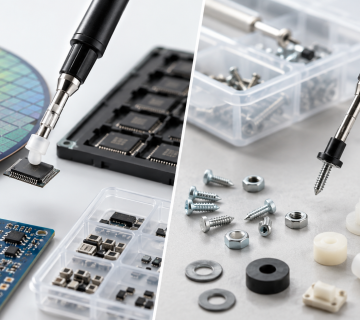
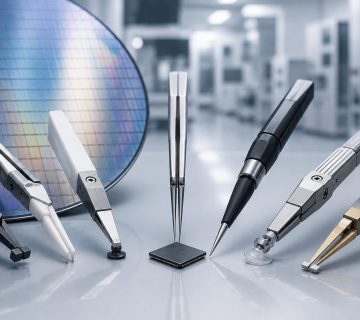
Precision semiconductor tooling — ejector pins, rubber tips, carbide tips, shear tools, and QA accessories — is typically light and compact by individual unit. However, the logistics cost of importing these items from offshore suppliers accumulates across multiple order cycles throughout the year. Air freight, which is routinely required for time-sensitive replenishment, is disproportionately expensive per kilogram relative to the unit value of precision tooling.
Surface freight alternatives reduce per-shipment cost but extend the supply chain timeline to 15 to 45 days depending on origin — eliminating the responsiveness advantage that precision tooling supply requires.
A local Malaysian supplier dispatching by domestic courier or regional freight eliminates international freight cost entirely for Malaysia-based buyers, and significantly reduces transit cost and timeline for ASEAN-region customers.
Customs Processing and Duties
Importing precision semiconductor tooling from non-FTA countries into Malaysia involves customs clearance procedures, potential import duties, and the administrative overhead of compliance documentation — including certificate of origin, commercial invoice verification, and HS code classification. For specialised tooling, incorrect HS classification by offshore suppliers is a recurring source of customs delays and additional costs that production schedules cannot absorb.
Malaysia’s extensive free trade agreement network — 16 bilateral and regional agreements including AFTA, CPTPP, and agreements with Japan, Australia, China, and the US — means that goods manufactured within Malaysia carry structural tariff advantages for export to a wide range of markets. For international buyers sourcing from LeaderRange HiTech in Malaysia and re-exporting finished assemblies, this FTA network is an active financial benefit, not a theoretical advantage.
Minimum Order Quantities
Many offshore precision tooling suppliers — particularly those structured around high-volume production economics — impose minimum order quantities (MOQs) that do not align with the demand patterns of HMLV semiconductor production environments. A facility running a high-mix line with multiple product configurations may require small batches of multiple tool types simultaneously, not large volumes of any single SKU.
Offshore MOQs force buyers into one of two unfavourable positions: ordering excess inventory that ties up working capital and risks obsolescence as product mixes change, or delaying replenishment until order quantities accumulate to the supplier’s minimum — creating a stock-out risk on active production lines.
Local suppliers who specifically serve HMLV environments — as LeaderRange HiTech does — structure their order acceptance around the realities of mixed-batch demand, removing the MOQ barrier without requiring buyers to compromise on cost or turnaround.
Lead Time Risk and Supply Chain Exposure
Standard lead times from offshore precision tooling suppliers typically range from 3 to 8 weeks from order confirmation to delivery. This timeline assumes no production disruption at the supplier, no port congestion, no customs delay, and no freight capacity constraint — assumptions that 2020 to 2024 global supply chain history demonstrated to be fragile.
A 3 to 8 week lead time means a buying organisation must carry 4 to 10 weeks of safety stock to maintain supply continuity — capital tied up in inventory that earns no return. For precision tooling with multiple variants and finite shelf life, this safety stock burden is both financially and operationally costly.
LeaderRange HiTech’s 10-day delivery commitment transforms this calculation. A 10-day lead time reduces the required safety stock buffer to days rather than weeks — freeing working capital, reducing the risk of holding obsolete tooling, and allowing procurement teams to respond to production schedule changes without inventory exposure.
Quality Certification: What ISO 9001:2015 UKAS Actually Means for Buyers
Quality certification is a frequently cited but poorly understood factor in tooling supplier evaluation. Not all ISO 9001 certifications are equivalent — the accreditation body behind the certification determines the rigour of the audit process and the credibility of the certification in global supply chains.
UKAS Accreditation: The Global Standard of Rigour
The United Kingdom Accreditation Service (UKAS) is the sole national accreditation body recognised by the UK government and internationally recognised under mutual recognition agreements with equivalent bodies in the US (ANAB), Europe (EA), Japan (JAB), and across the Asia-Pacific region (APAC MLA). A certification issued by a UKAS-accredited certification body — such as LeaderRange HiTech’s ISO 9001:2015 certification issued through Intertek — is therefore internationally portable and recognised by quality management teams across the full spectrum of global semiconductor manufacturers.
This matters for buyers because the ISO 9001:2015 framework, when properly implemented under UKAS-accredited audit, is not a paper exercise. It requires:
- A documented and functional quality management system governing every stage from design and procurement through production, inspection, and delivery
- Regular internal audits and management reviews
- Corrective action processes for non-conformances
- Customer satisfaction monitoring and feedback integration
- Continuous improvement evidence required at each surveillance and renewal audit
For procurement teams with supplier qualification requirements — whether imposed by their own quality system or by their customers further up the supply chain — a UKAS-accredited ISO 9001:2015 certification from a Malaysian tooling supplier satisfies the same qualification criteria as an equivalent certification from a European, Japanese, or US supplier.
The Certificate of Guarantee: A Commercial Commitment Beyond Certification
Quality certification describes a supplier’s process. A performance guarantee describes their commercial confidence in the product that process produces. LeaderRange HiTech’s Certificate of Guarantee commits to 100% product performance — with immediate replacement or refund within 60 days of invoice date for any product that does not meet specification.
This commercial guarantee is substantive and unusual. It converts the quality certification from a documentary assurance into an operational risk transfer — if the tool does not perform, the supplier bears the cost, not the buyer. For procurement managers managing tooling performance risk in production environments where non-conforming tools cause yield loss, this guarantee directly reduces the financial exposure of a new supplier qualification.
Comparing Quality Management Infrastructure
| Factor | Local supplier with UKAS ISO 9001:2015 | Offshore supplier — non-UKAS certified | Offshore supplier — no certification |
| QMS rigour | Internationally accredited | Varies by local accreditation body | Unverified |
| Audit frequency | Annual surveillance + triennial renewal | Varies | None |
| Global recognition | Yes — mutual recognition agreements | Partial | No |
| Supplier qualification | Satisfies multinational requirements | Case-by-case | Typically insufficient |
| Performance guarantee | LeaderRange: 60-day replacement/refund | Varies | Typically none |
| Customs documentation | Malaysian origin — FTA eligible | Depends on country | Depends on country |
Customisation Turnaround: The HMLV Production Imperative
The semiconductor assembly environment is not homogeneous. Different device types, package sizes, die geometries, and assembly equipment configurations require different tool specifications — and those specifications change as new products are introduced, equipment is upgraded, or customers impose specification revisions.
In a high-mix, low-volume production environment, the ability to receive customised tooling quickly is not a convenience feature. It is a core supply chain requirement. A production line waiting for a custom ejector pin configuration or a revised rubber tip geometry is a production line that is not producing — and downtime in semiconductor assembly is measured in lost units and delayed shipments, not in days of slack.
Offshore Supplier Customisation Reality
Offshore suppliers operating at scale typically structure their business around standard catalogue products. Custom orders — which require engineering review, tooling preparation, production scheduling, and quality approval before dispatch — compete with standard production for capacity, and custom lead times frequently extend to 4 to 10 weeks or beyond.
When a custom order is also a small-batch HMLV order, it may not receive priority scheduling against higher-volume standard work — extending the timeline further.
Local Supplier Customisation Advantage
LeaderRange HiTech’s customisation capability covers the full range of semiconductor precision tooling — from ejector needle geometry and rubber tip durometer specification through shear pin dimensions and epoxy stamping tool configurations — engineered to client-provided specifications.
Within Malaysia, the combination of local manufacturing, direct engineering communication without time-zone or language barriers, and a quality management system that governs custom as well as standard production means that customised tooling can be developed, approved, and delivered within LeaderRange’s standard 10-day operational window in many cases — a turnaround that offshore suppliers operating through international logistics chains structurally cannot match.
This customisation speed has direct P&L implications. A buyer who can receive custom tooling in days rather than weeks carries less safety stock of custom variants, responds faster to specification changes, and absorbs new product introductions without inventory exposure or schedule risk.
The Case for a Local Supplier Relationship in HMLV Environments
Beyond the transactional comparison of unit price, lead time, and MOQ, the operational value of a committed local supplier relationship compounds over time in ways that are difficult to quantify in a single procurement event but are clearly visible in a multi-year supply partnership.
Engineering Partnership and Specification Optimisation
A local supplier engaged in an ongoing relationship with a buyer’s production team develops direct familiarity with the buyer’s equipment configurations, tolerance requirements, and production challenges. This familiarity enables proactive suggestions — alternative materials, geometry adjustments, or tool configurations that reduce cost, extend tool life, or improve process yield — that a distant offshore supplier interacting only through order confirmations cannot provide.
LeaderRange HiTech’s 54+ global client relationships, including multinational accounts across 12+ countries, are built on this model: direct engineering engagement that produces an average 39% cost reduction for clients over the course of the supply relationship. That cost reduction is not achieved by cutting quality — it is achieved through specification optimisation and process knowledge that accumulates through a committed partnership.
Communication and Response Time
When a tool specification question arises at 9am on a Monday, the ability to speak with a supplier’s engineering team in the same time zone — and receive a substantive response before the production shift ends — has measurable operational value. With offshore suppliers in Europe or East Asia, a 9am Monday question may not receive a response until Tuesday or Wednesday local time, after the production shift that needed the answer has already been managed through improvisation.
LeaderRange HiTech’s 92% same-day response rate reflects a service model structured around this operational reality — not around call centre queues or ticket systems.
Supply Continuity and Relationship Resilience
A local supplier with whom a buyer has a documented supply relationship is a substantially more resilient supply chain asset than an offshore supplier engaged on a transactional basis. When supply disruptions arise — from logistics constraints, production issues, or specification emergencies — the quality of the pre-existing relationship determines the quality of the response. A supplier who knows your production environment, your technical requirements, and your business stakes responds differently from a supplier receiving its first interaction with your procurement team during a crisis.
LeaderRange HiTech: Local Manufacturing, Global Reach
LeaderRange HiTech has been manufacturing precision semiconductor tooling from Penang, Malaysia since 2006 — ISO 9001:2015 UKAS certified since the company’s first year of operation, serving clients across 12+ countries with over 71,000 completed deliveries.
The product range covers the three core tooling domains in semiconductor back-end manufacturing:
Die Bond Tools — ejector pins and ejector needles in standard and hybrid configurations, rubber pick-up tips, epoxy stamping tools, and carbide tips for die placement and adhesive dispensing applications.
Wire Bond Tools — EFO (Electrode Flame Off) electrodes and related wire bonding accessories for gold and copper wire bonding processes.
QA Tools — shear pins and shear tools for bond strength testing, wire pull hooks for wire pull force measurement, and associated quality assurance accessories.
All products are manufactured under the ISO 9001:2015 UKAS-accredited quality management system, backed by the Certificate of Guarantee, and dispatched within a 10-day lead time — including custom and modified configurations where production scheduling permits.
For buyers in Malaysia’s semiconductor cluster who are evaluating their current tooling supply arrangements, or for international buyers seeking a Malaysian-origin supplier with a documented global delivery track record, the comparison across lead time, customs, MOQ, quality certification, and customisation responsiveness consistently points in the same direction.
Conclusion: The Total Cost of Sourcing Is Not the Unit Price
The semiconductor tooling sourcing decision is a total cost decision — and total cost is not captured by the ex-works price per unit on a supplier’s price list. It is captured by the sum of unit cost, freight, customs exposure, inventory carrying cost, MOQ buffer stock, customisation lead time cost, supply disruption risk, and the engineering value of the supplier relationship.
When that full accounting is applied, the case for a qualified local Malaysian precision tooling supplier — with internationally accredited quality certification, a performance guarantee, a demonstrated HMLV service model, and a 10-day delivery commitment — is considerably stronger than a unit-price comparison alone suggests.
For project requirements, custom specifications, or supply partnership discussions, contact LeaderRange HiTech directly, or explore the full product range covering die bond, wire bond, and QA tooling for semiconductor manufacturing applications. For quality documentation, visit the Quality & Certifications page.
LeaderRange HiTech Sdn Bhd — ISO 9001:2015 UKAS certified precision semiconductor tooling manufacturer, Penang, Malaysia. Serving 54+ clients across 12+ countries since 2006.