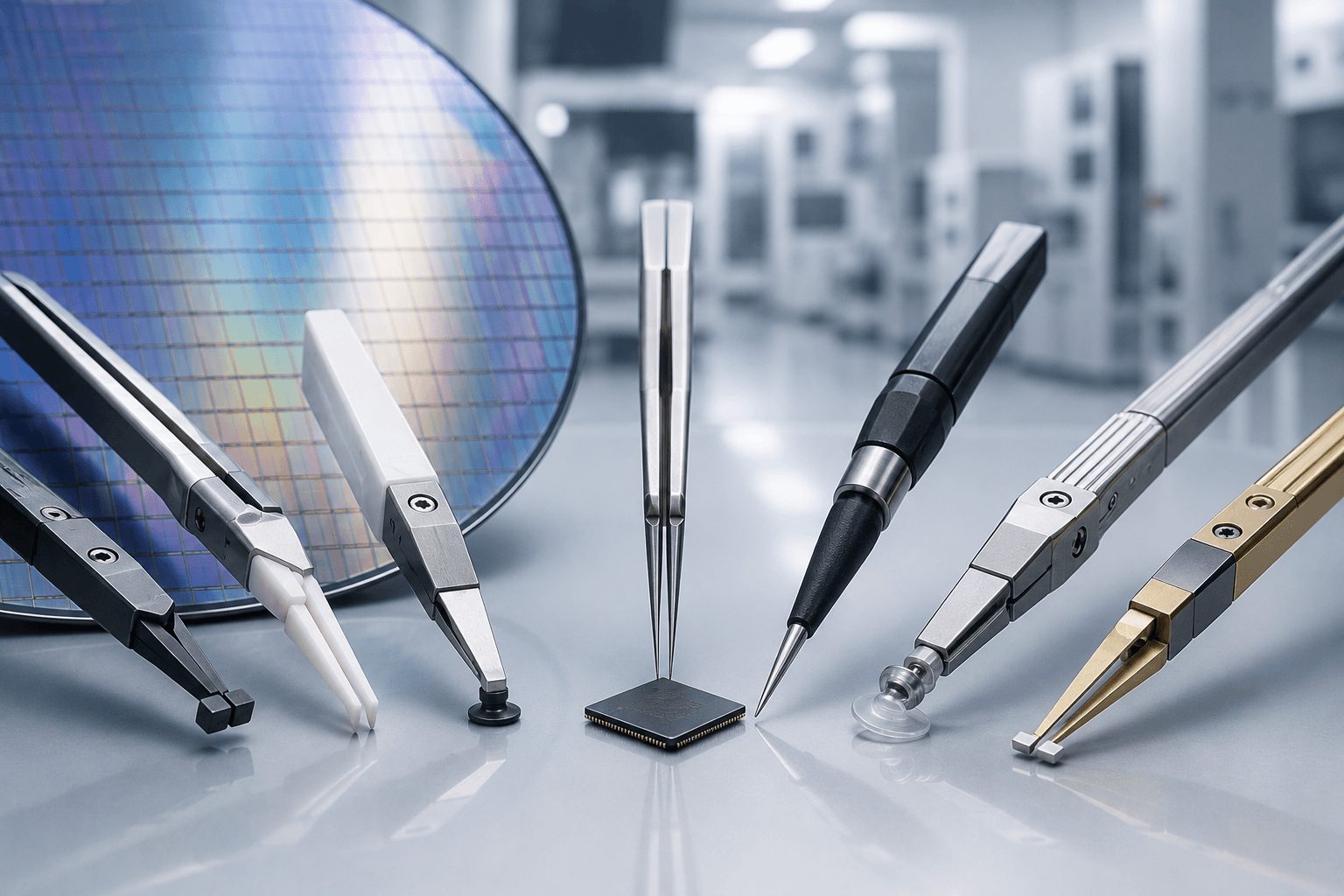
Key Takeaways
- Pick-up tool material choice directly affects die protection, contamination control, and tool lifespan.
- The three main material families are tungsten carbide, rubber/elastomer compounds, and engineering plastics.
- The “best” material depends on die fragility, temperature exposure, and process cycle count — not a single universal winner.
What is the best material for a semiconductor pick-up tool?
There isn’t one best material — there’s a best material for your process. Pick-up tools handle everything from ultra-thin bump dies to standard packages, and each material family trades off differently between hardness, cushioning, heat resistance, and cost. Understanding those trade-offs is what actually improves yield.
What Determines the Right Pick-Up Tool Material?
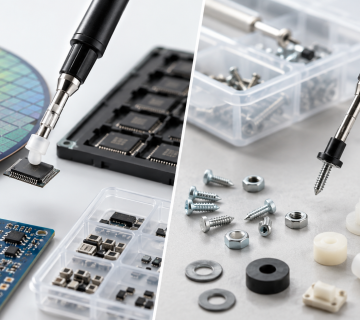
A pick-up tool retrieves and positions semiconductor dies during die attach and pick-and-place operations. Because dies are small, fragile, and contamination-sensitive, the material in contact with the die matters as much as the mechanism itself. Material selection is generally driven by three factors:
- Die sensitivity — how easily the surface scratches or cracks
- Temperature conditions — the heat the tip is exposed to during bonding
- Required lifespan — how many cycles the tip must withstand before replacement
Tungsten Carbide
Tungsten carbide is the hardest common material used in pick-up and ejector tooling.
- Hardness: 82HRC–85HRC, positioning it just below diamond on the hardness scale
- Heat resistance: rated for working temperatures up to 2000°C
- Surface finish: capable of a mirror-like, ultra-flat finish that reduces friction and improves contact precision
- Binder: cobalt is typically used to add toughness and shock resistance to the tungsten carbide structure
Carbide is best suited to high-force, high-cycle applications such as standard ejector needles and sorting automation, where dimensional stability over thousands of cycles matters more than cushioning.
Rubber and Elastomer Compounds
Where die fragility is the priority, rubber-based tips are the standard choice. Rubber tips come in several material variants, each suited to different conditions:
- NBR (Nitrile Butadiene Rubber) — the standard rubber tip material, offering firm grip and oil resistance
- Viton — a high-temperature variant rated up to 250°C, for bonding stages that involve heat
- Silicone Rubber — valued for heat resistance, flexibility, and chemical stability
- EPDM — offers strong elasticity and wear resistance for repeated-contact applications
- Polyurethane (PU) — higher abrasion resistance, suited to high-throughput operations
Rubber tips are typically available across a hardness range of 50HRC to 80HRC, letting engineers dial in exactly how much cushioning a given die requires — critical for bump dies, LED packages, and other surface-sensitive components.
Engineering Plastics
For applications where scratch risk must be minimised without the added cost or hardness of carbide, engineering plastics offer a middle ground:
- POM (Polyoxymethylene) — good stiffness and low friction
- PI (Polyimide) — high temperature tolerance for demanding thermal cycles
- PAI (Polyamide-imide) — combines strength with reduced scratch risk on fragile dies
These materials are generally used where thin or delicate dies need protection but rubber’s flexibility isn’t required.
Materials Comparison Table
| Material Family | Hardness/Feel | Heat Resistance | Best For |
|---|---|---|---|
| Tungsten Carbide | 82HRC–85HRC (rigid) | Up to 2000°C | High-force, high-cycle ejection |
| Rubber (NBR/Viton/Silicone/EPDM/PU) | 50HRC–80HRC (cushioned) | Up to 250°C (Viton) | Fragile, surface-sensitive dies |
| Engineering Plastics (POM/PI/PAI) | Moderate, low-friction | Varies by grade (PI rated for high heat) | Thin/delicate dies needing scratch protection |
Why Material Selection Matters
✅ Yield and defect reduction
The wrong material — too hard for a fragile die, or too soft for a high-force process — directly increases scratch, crack, and misalignment defects.
✅ Contamination control
Material choice affects particle generation and surface interaction, both of which matter in cleanroom-sensitive semiconductor environments.
✅ Tool lifespan and cost
Carbide’s durability reduces replacement frequency in high-cycle stations; rubber’s lower cost suits faster-wearing, gentler-contact stages.
How to Choose the Right Material for Your Pick-Up Tools
- Assess die fragility — thin, bump, or surface-sensitive dies point toward rubber or engineering plastics
- Check process temperature — extreme heat narrows the field to carbide or Viton rubber
- Estimate cycle count — high-volume, repeated operations favour carbide’s wear resistance
- Confirm machine compatibility — tip material and geometry should suit your bonder make and model
- Factor in customisation needs — material, hardness grade, and tip shape can all be matched to drawings or samples
Best Practices for Pick-Up Tool Material Selection
- Don’t standardise on one material across all die types — match material to each process stage
- Re-evaluate material choice when introducing thinner or more fragile die packages
- Track wear cycles by material type to optimise replacement scheduling
- Request sample-based material matching when specifications are unclear
Conclusion
The best material for a semiconductor pick-up tool depends on what the die itself demands: tungsten carbide for durability under high-force, high-cycle conditions; rubber compounds for cushioned protection of fragile dies; and engineering plastics as a scratch-resistant middle ground. Getting this match right is one of the simplest ways to reduce defects and extend tool life.
👉 Read More: Pick Up Tools in Semiconductor Manufacturing: Types, Materials & Applications
Contact LeaderRange HiTech Sdn Bhd for more details.
FAQs About Pick-Up Tool Materials
What is the hardest material used in semiconductor pick-up tools?
Tungsten carbide, with a hardness of 82HRC–85HRC, is the hardest common material used in pick-up and ejector tooling.
What rubber material is used for high-temperature pick-up tools?
Viton, a high-temperature rubber variant, is rated for working temperatures up to 250°C, making it suitable for heated bonding stages.
Why would engineering plastics be chosen over rubber or carbide?
Engineering plastics like POM, PI, and PAI offer a middle ground — lower scratch risk than carbide, without the flexibility (or wear pattern) of rubber, and are useful for thin or delicate dies.
Can pick-up tool materials be customised for specific dies?
Yes. Material, hardness grade, and tip geometry can be matched to customer drawings, samples, or specific machine models.
Does material choice affect contamination control in semiconductor manufacturing?
Yes. The wrong material can increase particle generation or surface interaction risk, both of which matter in contamination-sensitive semiconductor environments.