
Why do some wire bond failures only appear after products are already in the field—and how can they be prevented earlier?
In semiconductor manufacturing, the answer often lies not in the bonding process itself, but in the precision and reliability of the shear tool used during testing.
In this article, we explain how shear tool precision directly influences test accuracy, product reliability, and long-term manufacturing cost.
By examining wire bond shear test standards, failure analysis requirements, material durability, and manufacturing precision, this guide positions the shear tool not as a consumable cost—but as a critical investment that safeguards quality and prevents expensive downstream failures.
The Role of the Shear Tool in Semiconductor Quality Control
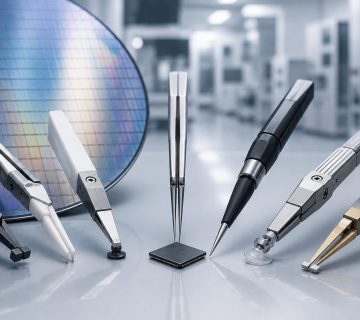
A shear tool is used in mechanical testing to measure the strength of wire bonds by applying a controlled lateral force until failure occurs. The resulting data helps manufacturers verify bond integrity, assess process stability, and identify potential reliability risks.
In a wire bond shear test, the shear tool must:
- Contact the bond at a precise height and angle
- Apply force smoothly and consistently
- Produce repeatable, standard-compliant results
Any deviation in tool geometry or condition directly affects the validity of the test data.
Why Precision Matters in Wire Bond Shear Testing
Wire bonds are microscopic structures, often measured in microns. At this scale, even minimal tool wear or dimensional variation can significantly alter test outcomes.
Precision Affects Test Accuracy
A high-precision shear tool ensures:
- Correct load application point
- Minimal slippage or unintended deformation
- Accurate force-to-failure measurement
Without precision, test results may falsely indicate weak bonds—or worse, fail to detect real defects.
Industry Standards Demand Tool Consistency
Wire bond shear testing is governed by well-established industry standards, including requirements for tool geometry, edge condition, and alignment.
Industry Expectations Include:
- Consistent shear height relative to the bond
- Controlled blade sharpness and profile
- Repeatable test results across batches
A shear tool that does not meet these criteria introduces variability that compromises compliance and audit readiness.
Shear Tool Precision and Failure Analysis
Failure analysis relies on shear test results to distinguish between:
- Bond interface failure
- Wire breakage
- Pad metallisation issues
A worn or poorly manufactured shear tool can damage the bond in unintended ways, obscuring the true failure mode. This leads to misdiagnosis, incorrect corrective actions, and extended troubleshooting cycles.
Precision tools enable clean, interpretable fractures that support reliable root-cause analysis.
Durability: Why Long-Lasting Shear Tools Matter
Shear tools operate under repeated mechanical stress. Over time, inferior tools experience:
- Edge rounding
- Micro-chipping
- Dimensional drift
These changes degrade performance gradually, often without immediate detection.
A Durable Shear Tool:
- Maintains geometry over extended cycles
- Reduces frequency of recalibration
- Minimises unplanned downtime
From a cost perspective, durability directly translates into lower total cost of ownership.
Precision Manufacturing: Not All Shear Tools Are Equal
The performance of a shear tool begins at manufacturing.
High-quality shear tools are produced using:
- Precision grinding and polishing
- Tight dimensional tolerances
- Advanced materials engineered for wear resistance
Poorly manufactured tools may appear acceptable initially but degrade rapidly under real testing conditions.
Shear Tool as an Investment, Not an Expense
It is tempting to view a shear tool as a replaceable consumable. However, this perspective overlooks hidden costs.
Hidden Costs of Low-Quality Shear Tools:
- Frequent replacement
- Increased calibration time
- Inconsistent test results
- False failures or missed defects
By contrast, a high-precision, long-lasting shear tool reduces:
- Maintenance frequency
- Operator intervention
- Risk of undetected reliability issues
The initial investment is offset by long-term savings and higher confidence in test outcomes.
Calibration Stability and Process Efficiency
Calibration is essential in wire bond shear testing. Tools that wear quickly require frequent recalibration, disrupting production flow.
A precision-engineered shear tool:
- Retains calibration longer
- Reduces test interruptions
- Supports higher throughput
In high-volume semiconductor manufacturing, these efficiencies compound significantly over time.
Preventing Costly Field Failures
Field failures are among the most expensive issues a semiconductor manufacturer can face. They involve:
- Product recalls
- Warranty claims
- Reputation damage
Many field failures trace back to bond integrity issues that could have been detected during testing—if the testing tools were precise enough.
A reliable shear tool improves early defect detection, acting as a critical safeguard before products leave the factory.
Aligning Quality, Reliability, and Manufacturing Goals
Shear tool precision sits at the intersection of:
- Quality assurance (accurate testing)
- Failure analysis (clear, interpretable results)
- Durability (long service life)
- Manufacturing efficiency (reduced downtime)
Investing in a precision shear tool aligns these objectives, supporting both technical excellence and business performance.
Conclusion: Precision Is the Foundation of Reliability
In wire bond testing, reliability begins with precision. A shear tool that delivers consistent geometry, durability, and repeatable performance is not merely a testing accessory—it is a critical quality assurance asset.
By positioning the shear tool as an investment rather than a cost, manufacturers can reduce maintenance overhead, improve test confidence, and prevent costly field failures.
In an industry where microscopic defects can have massive consequences, precision tooling remains one of the most effective safeguards for long-term reliability and success.
Discover our custom-designed die shear tools engineered for precise, reliable test conditions.